
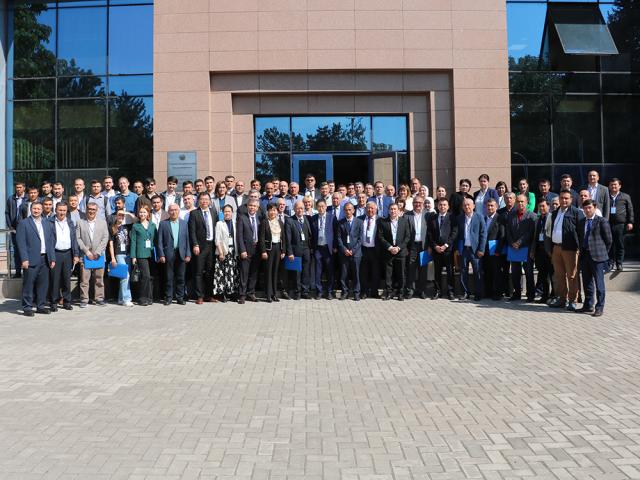
On October 3-4, 2024, the next IX International Scientific Conference on "Physical Electronics" (IPEC-9) was held in Tashkent at the U.A. Arifov Institute of Ion-Plasma and Laser Technologies of the Academy of Sciences of the Republic of Uzbekistan (AS RUz). The conference was organized in collaboration with the AS RUz, the Ministry of Higher Education, Science, and Innovations, and the U.A. Arifov Institute of Ion-Plasma and Laser Technologies.
Scientists from universities and leading research centers of countries such as China, the USA, Russia, Belarus, Pakistan, and Norway, as well as research institutes of the Academy of Sciences of the Republic of Uzbekistan and higher educational institutions, including the Institute of Ion-Plasma and Laser Technologies, the Institute of Nuclear Physics, the International Solar Energy Institute, the Physics-Technical Institute, NUUz, Tashkent Technical University, SamSU, NamSU, KarSU, and UrgSU, along with young researchers, actively participated in the conference.
At the conference, 32 oral and 101 poster presentations were heard and discussed in offline and online formats in the following areas: interaction of atoms and molecules with the surface of solid bodies; fundamental problems of adsorption, electron and ion emission; physical electronics (methods and devices); ion-beam and plasma technologies, material production and modification; new technologies and materials for electronics and solar energy; photonics; physics and technology of nanomaterials.
The analysis of the presented works demonstrated that the research results on adsorption, electron and ion emission, and the interaction of particles with the surface of solid bodies can be applied to create a general theory of the interaction of polyatomic particles with solid surfaces, as well as to understand the processes of forming charged and excited states of particles emerging from surfaces.
New achievements in ion-beam and plasma technologies for the production and modification of materials, structural and semiconductor materials, as well as results on the study of solid surfaces using secondary emission and optical spectroscopy, were discussed. Works on new technologies for obtaining materials for solar energy and electronics, which are important for Uzbekistan's economy, were presented. It was emphasized that more attention should be paid to increasing the efficiency of new materials and developing cheaper technologies and materials, as well as expanding fundamental and applied research on the production of organic solar materials.
Today, one of the pressing fields in physics is the physics and technology of nanomaterials. In this area, the current state of nanomaterial production, new technologies, and the development of nanomaterial physics were widely discussed, as well as issues of computer modeling of carbon nanotube synthesis and determining their physicochemical properties. Nonetheless, it was noted that more attention should be given to studying the properties of nanomaterials and developing new, simpler technologies and synthesis methods.
As part of the conference, visits to the institute’s laboratories were organized for scientists from China, Russia, and Uzbekistan, allowing them to familiarize themselves with the institute’s research activities and discuss the scientific results and innovations being developed. As a result, new scientific collaborations were established between foreign and institute scientists, laying the groundwork for further development.