
|
Head of the Laboratory: e-mail: urol_m@mail.ru , urolmakh@gmail.com |

The main scientific directions of the laboratory:
- Optical and nonlinear-optical properties of nanoscale objects;
- Infrared spectroscopy of nanosized particles;
- Spectrometric analysis of nanodispersions
- Study of the physical features of pure powders and solutions of nanosized materials (for example, fullerenes С60, С70, С76, …, endo- and hexahedral derivatives of fullerenes, single- and multilayer nanotubes) in various organic solvents;
- Controlled synthesis of monomolecular crystalline and fractal nanoaggregates of C60 and C70 fullerenes in solutions;
- Synthesis of nanoscale organic structures (nanowhiskers, nanotubes, nanofilms, nanocoatings) based on fullerenes and their derivatives;
- Synthesis of heteromolecular structures in two- and multi-component water-organic media;
- Numerical modeling and theoretical study of intermolecular interactions in liquid systems.
The laboratory "Optics and Spectroscopy" of the Institute of Ion-Plasma and Laser Technologies of the Uzbekistan Academy of Sciences was founded in 1978. The initiator of its creation and the first leader was Doctor of Physical and Mathematical Sciences, Academician Bakhramov S.A. Scientific group of the laboratory has many years of experience in the field of laser physics, optics and nonlinear optics, plasma physics, nanophysics and nanotechnologies. The laboratory conducts experimental and theoretical research in the field of physics of nanoscale structures (fullerenes, their endo- and exohedral derivatives, nanotubes), ionization and polarization spectroscopy of saturated alkali metal vapors, nonlinear interaction of laser radiation with matter (including biological objects), and also interactions of ions with biomolecules. They were the first to experimentally discover a phenomenon of resonant nonlinear optical deviation of the polarization ellipse of laser radiation in alkali metals, crystals and pure biological solutions, as well as in solutions of nanosized particles in various organic liquids. Laboratory staff experimentally studied the features of the dissolution of C60 and C70 fullerenes, as well as their endo- and hexahedral derivatives in a number of one- (toluene, benzene, xylene, hexane, …) and two- (toluene + acetonitrile, toluene + ethanol, benzene + acetonitrile, xylene + hexane, …) component organic solvents. The electronic and IR absorbtion spectra of C60 and C70 solutions, C60+C70 mixtures in single- and multi-component solvents have been studied at different initial concentrations of fullerenes and at different stages of storage after solution preparation. For the first time, the main physical regularities of the processes of self-assembly and self-organization of C60 and C70 fullerene molecules in various one- and two-component organic solvents have been established. Controlled selective methods have been developed for the preparation of both monomolecular close-packed and fractal porous nanoaggregates of (C60)m and (C70)m fullerenes in solutions of various shapes and sizes (where m is the number of С60 and С70 molecules in nanoaggregates).
The effect of self-induced nonlinear rotation of the polarization ellipse (NRPE) of pulsed laser radiation in solutions of C60 and C70 has been experimentally discovered and studied. The high sensitivity of the NRPE effect to the initial concentration of fullerenes in solutions, the replacement of the solvent, as well as the formation and growth of the sizes of (C60)m and (C70)m aggregates in solutions has been demonstrated.
On May 28, 2021, the head of the laboratory "Optics and Spectroscopy" Makhmanov U.K. successfully defended his doctoral dissertation and received a Doctor of Science (DSc) degree in physical and mathematical sciences, specialty 01.04.05 - "Optics".
At present, in the scientific laboratory "Optics and spectroscopy" Ph.D. Ismailova O.B. is actively working on her DSc dissertation, and doctoral students Esanov Sh.A. and Bozorova D.T. conduct research on their PhD dissertations. Laboratory staff periodically supervises the implementation of bachelor's and master's theses on scientific topics of the laboratory.
Laboratory staff periodically supervise master's theses of the National University of Uzbekistan named after Mirzo Ulugbek, Namangan State University and Termez State University on scientific topics of the laboratory.
Main scientific fundamental results:
For the first time, the main physical regularities of the processes of self-organization of C60 and C70 fullerene macromolecules in various one- and two-component organic solvents (toluene, benzene, xylene, toluene + ethanol, toluene + acetonitrile, benzene + ethanol, xylo + hexane, etc.) have been established.
The size characteristics and structural features of nanoaggregates of (C60)m and (C70)m fullerenes synthesized in one- and two-component organic solvents are revealed.
Microscopic studies (high-resolution atomic force and high-resolution transmission electron microscopy) of C60 and C70 solutions in toluene, benzene, and xylene prepared in two different ways, equilibrium and nonequilibrium, made it possible to establish the possibility of synthesizing both fractal and monomolecular close-packed nanoaggregates (C60)m and (C70)m, respectively.
The influence of the processes of self-assembly and self-organization of C60 and C70 fullerene macromolecules in organic solvents on the spectroscopic and nonlinear optical properties of solutions has been revealed.
For the first time, experimental methods for controlled synthesis of both close-packed monomolecular and loose fractal nanoaggregates (C60)m and (C70)m in solutions with geometric dimensions in diameter up to d~50 and D~600 nm, respectively, have been developed.
For the first time, a method for the accelerated synthesis of both nanostructured fractal and close-packed clusters of fullerenes (С60)m and (С70)m in the volume of evaporating "solution droplets" located on a flat substrate surface has been proposed and implemented.
For the first time, a “drop method” has been proposed for obtaining nano- and microsized organic structures (nano-whiskers, nanotubes, nanofilms and nanocoatings) consisting of C60 fullerene macromolecules.
For the first time, the effect of nonlinear self-rotation of the polarization ellipse of pulsed laser radiation (l»532 nm) in C70 solutions in a number of one- and two-component organic solvents (toluene, benzene, toluene + acetonitrile, toluene + ethanol) was experimentally studied. It has been found that the nonlinear self-rotation of the polarization ellipse effect is observed in the case of elliptical polarization of laser radiation and disappears in the case of linear polarization.
A correlation has been found between the processes of formation and growth of mC60/70 clusters in solutions and the magnitude of the nonlinear self-rotation of the polarization ellipse angles of laser radiation transmitted through the medium. It is shown that an increase in the concentration of C60/70 fullerene in solutions leads to a noticeable decrease in the specific rotation of the laser radiation polarization ellipse.
Specific values of the nonlinear refractive indices and nonlinear susceptibilities of solutions of C70 and C60/70 fullerenes in toluene, benzene, and toluene+acetonitrile mixtures are determined over a wide range of fullerene concentrations and at various degrees of laser radiation ellipticity.
For the first time, the change in excess values of the complex permittivity of aqueous solutions of dimethylformamide, tetrahydrofuran and ethanol has been studied by the method of molecular dynamics in a wide temperature range (20-60 °С).
The formation of time-stable heteromolecular complexes "tetrahydrofuran+water", "dimethylformamide+water", "ethanol+water", "tetrahydrofuran+dimethylformamide", etc. has been shown for the first time by optical refractometry.
The dependence of the density of the synthesized heteromolecular aggregates in various binary solvents on the initial concentrations of the components, as well as the storage time of the solutions, has been established.
Main scientific applied results:
Controlled selective methods have been developed for obtaining both monomolecular close-packed crystalline and fractal porous nanoaggregates of C60 and C70 fullerenes in solutions of various shapes and sizes.
Indirect experimental methods have been developed for diagnosing the processes of self-organization and self-assembly of fullerene macromolecules, as well as for determining a degree of stability of synthesized fullerene nanoclusters in solutions by optical spectroscopy.
Controlled selective methods have been developed for the production of nanoscale organic structures (nanowhiskers, nanotubes, nanofilms and nanocoatings) based on C60 fullerene in the volume of evaporating solution droplets.
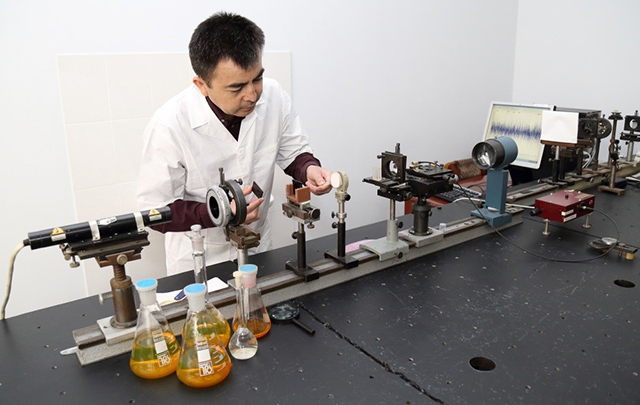
The laboratory maintains close scientific contacts with many scientific centers in the USA, Europe, and the CIS countries, including the University of Texas and the Institute of Nanotechnology of the University of Texas (Dallas, USA), the Institute of Colloids in Berlin, the Institute of Nonlinear Optics and Short Pulse Spectroscopy named after Max Born (Berlin, Germany), Moscow State University named after M.V. Lomonosov, Institute of General Physics, A.M. Prokhorov, Academy of Sciences, Institute of Spectroscopy RAS, Institute of Laser Physics SB RAS (Novosibirsk), Institute of Physics, L.V. Kirensky, SB RAS (Krasnoyarsk, Russia), Taras Shevchenko National University of Kyiv, Institute of High Technologies at Kyiv National University, Institute of Physics of the National Academy of Sciences of Ukraine; Institute of Physics, B. I. Stepanova, of the National Academy of Sciences (Belarus), the University of Latvia (Riga, Latvia), etc.
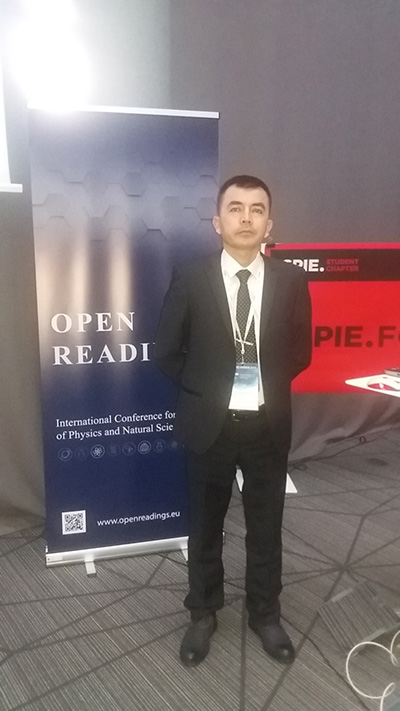 Dr.Makhmanov U.K. at the international conference at Vilnius University in 2019 (Vilnius, Lithuania) |
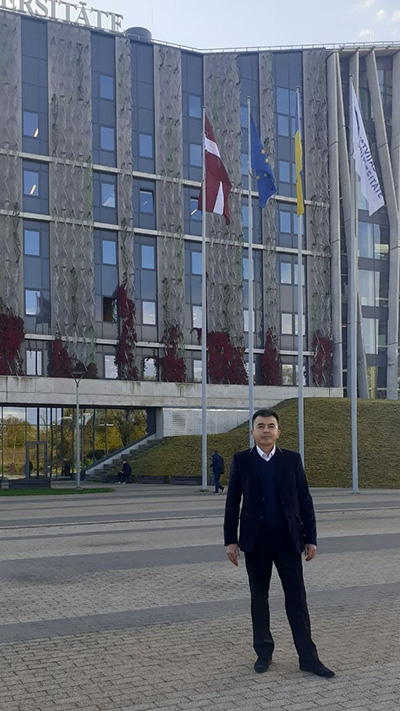
Dr. Makhmanov U.K. in a scientific internship at the Institute of Chemical Physics of the University of Latvia (2022, Riga, Latvia) |
COLLABORATION WITH RESEARCH CENTERS
- University of Texas and University of Texas Institute of Nanotechnology (Dallas, USA)
- Institute of Colloids in Berlin (Berlin, Germany)
- Institute of Nonlinear Optics and Spectroscopy of Short Pulses. Max Born (Berlin, Germany)
- Lomonosov Moscow State University (Russia)
- Institute of General Physics. A.M. Prokhorov RAS (Russia)
- Institute of Spectroscopy RAS (Russia)
- Dongguk University in Seoul (Republic of Korea)
- Institute of Laser Physics SB RAS (Novosibirsk, Russia)
- Institute of Catalysis and Inorganic Chemistry of Azerbaijan National Academy of Sciences (Baku, Azerbaijan)
- Institute of Physics. L.V. Kirensky SB RAS (Krasnoyarsk, Russia)
- Taras Shevchenko National University of Kyiv (Kyiv, Ukraine)
- Institute of High Technologies at Kiev National University (Kyiv, Ukraine)
- Institute of Physics of the National Academy of Sciences of Ukraine (Ukraine)
- Institute of Physics. B. I. Stepanov of the National Academy of Sciences (Belarus)
- University of Latvia (Riga, Latvia)
- National University of Uzbekistan named after M. Ulugbek
- Samarkand State University named after. A. Navoi
- Karshi State University
- Namangan State University
- Tashkent State Technical University
- Termez State University
Projects:
- 2017-2020 Draft program of fundamental research Ministry of Innovative Development of the Republic of Uzbekistan. №OT-F2-05 "Fundamental principles for the synthesis of new functional nanomaterials for optoelectronics and solar energy based on fullerenes and their derivatives"
- 2017-2020 Draft program of fundamental research Ministry of Innovative Development of the Republic of Uzbekistan. №VA-FA-F6-010 "Heteroatoms in natural compounds: intermolecular interaction, receptor recognition, pharmacophores"
- 2012-2016 Draft program of fundamental research of the Academy of Sciences of the Republic of Uzbekistan. No. F2-FA-F146+F143: "Investigation of optical, nonlinear optical processes in molecular and supramolecular systems."
Material and technical base of the laboratory
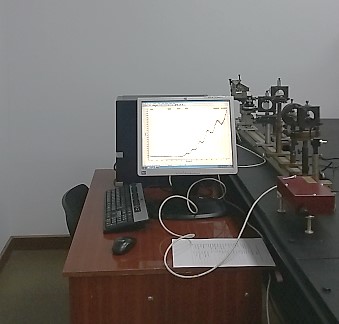 Optical experimental setup for recording electronic absorption spectra of nanoparticle solutions |
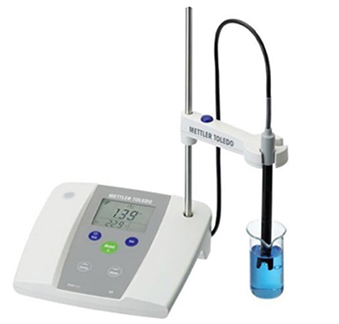 High-precision laboratory stationary device for measuring pH and electrical conductivity of liquid media brand FiveEasy™ (METTLER TOLEDO, Russia) |
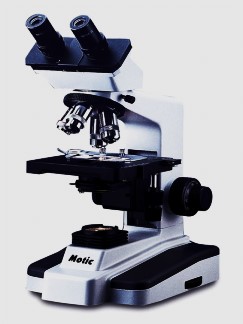 Optical binocular microscope brand «Motic B1-220A» (1000x magnification) |
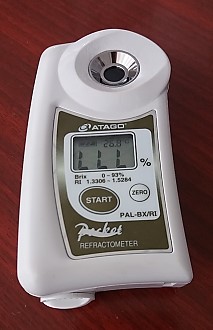 High-sensitivity digital refractometer brand "PAL-BX/RI" (production ATAGO, Japan) for measuring the exact values of the refractive index of liquid media |
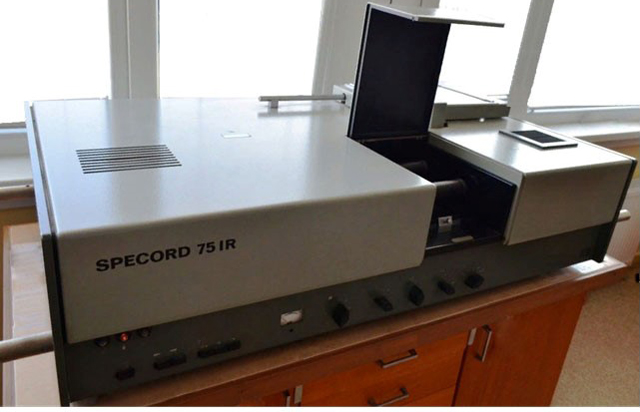
Spectrophotometer brand SPECORD 75IR (CARL ZEISS, Germany) for measuring infrared absorption spectra of samples