
 |
Head of laboratory: Yadgarov Ishmumin Jabborich e-mail: ishmuminyadgarov@gmail.com |
Scientific directions of the laboratory
- Photoionazition processes in carbon nanostructures
- Temperature dynamics of carbon nanostructures interacting with low energy atoms
- Interaction processes of low energy atoms and clusters with carbon nanostructures
The scientific team of the laboratory unites young specialists, employees and graduate students with many years of experience, who have the degrees of Doctor of Science, DSc, PhD.
The scientific group of the "Modeling of Physical Processes" laboratory of the UzR FA IPLTI has many years of experience in the field of theoretical studies of the interaction of electrons, photons and atoms with elements of carbon nanostructures in isolation and methods of computer simulation of adsorption processes on the crystal surface. In recent years, the specialists have studied the scattering processes of nitrogen and beryllium atoms in free C60 fullerenes, the temperature dynamics of free C60 fullerenes, interference and other processes of elastic scattering of electrons by spherical targets.
At the moment, 3 candidates of sciences are conducting scientific work on theses in the IPLTI "Modeling of Physical Processes" scientific laboratory of the Academy of Sciences of the Republic of Uzbekistan. During the last three years, 4 candidate theses were defended in the field of laboratory. Laboratory employees actively participate in international and national conferences.
In the framework of scientific international cooperation, the laboratory collaborates with Prof. I. Woiciechowski (USA), Prof. F.F. Umarov (Kazakhstan-British Technical University, Kazakhstan).
A number of achievements of the laboratory on new high-tech developments were presented at international conferences (ACNS'2019 14th International Conference Advanced Carbon NanoStructures Saint-Petersburg, Russia, July 1-5, 2019), (50th Annual Meeting of the APS Division of Atomic, Molecular and Optical Physics, May 27-May 31, 2019, Milwaukee, Wisconsin, USA), (Tenth International Conference on Vacuum Electron Sources – IVESC-2014).
Among scientific achievements, the paper of Baltenkov A.S. and others "Certificate from Journal of Physics B: Atomic, Molecular and Optical Physics" was selected by the editors of "Interference in the molecular photoionization and Young's double-slit experiment" journal as the most important events of 2012 according to citation, novelty, scientific importance.
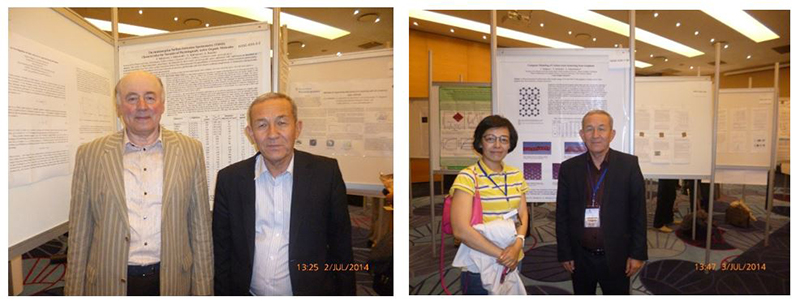
I.D. Yadgarov at the IVESC conference, St. Petersburg, Russia
Main scientific fundamental results
- The developed method for calculating Wigner delay times was generalized to the case of C20, C72 and C80 spherical fullerenes, which allowed calculation of the partial times used to calculate the average Wigner delay times for these spherical fullerenes;
- Due to the instantaneous ionization of the inner atom A, it was shown that the phenomenological potentials modeling the CH shell for the endohedral potential A@CH should belong to the family of potentials, in contrast to the non-flat core. As a specific example, the photoionization cross sections of He, Ar, and Xe atoms located in the center of the C60 shell were calculated with and without taking into account the monopole polarization of the fullerene shell accompanying this process. Surprisingly, monopole polarization was found to have no effect on the photoionization cross sections of these endohedral atoms, a rare example of potential "masking";
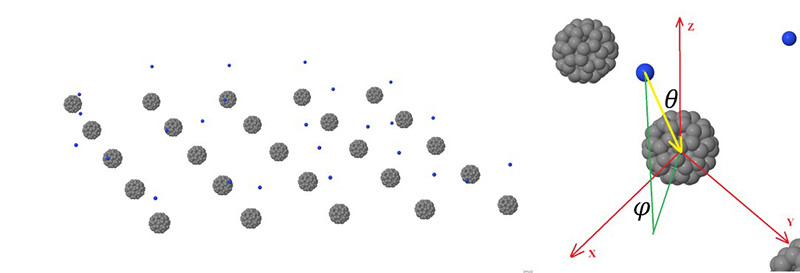
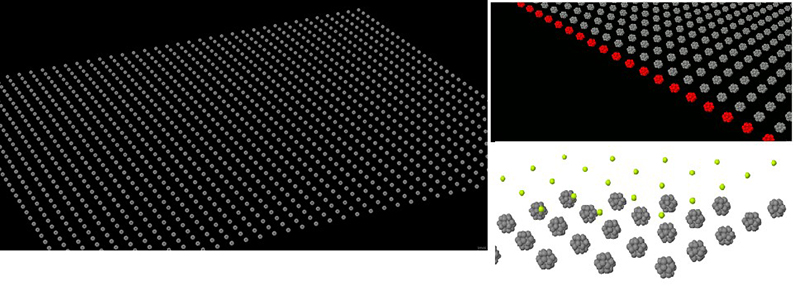
- The picture of atomic scattering in C60 fullerene, using BeC60 scattering as an example obtained by the LAMMPS software package is generally consistent with the picture of such a process obtained by quantum mechanical approaches;
- Using the LAMMPS software package, it has been determined that the temperature fluctuations of atoms in C60 and C20 fullerenes are mainly radial in nature, and the fullerene radii change over a wide temperature range. 0.01 Å ).
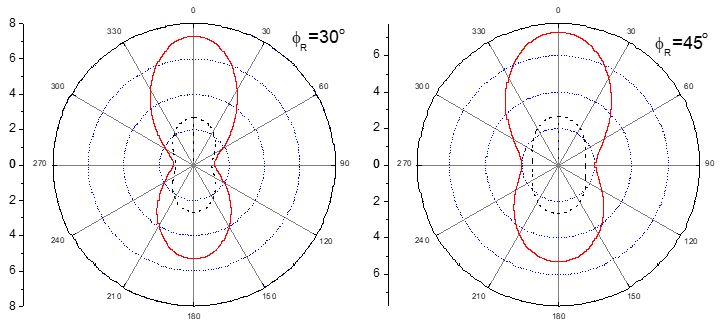
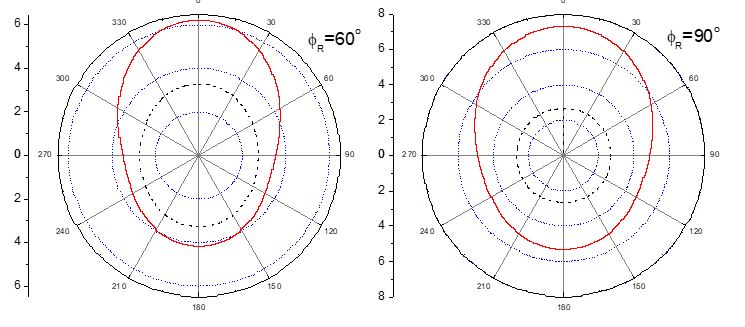
Together with Prof. A. Z. Msezane (Department of Physics, Clark Atlanta University, USA) the calculations of the elastic scattering cross sections of slow electrons in C2 molecules within the model of non-intersecting atomic potentials were performed. To calculate the amplitude of multiple scattering of the electron wave, the wave function of the molecular continuum is expressed as a combination of a plane wave and two spherical waves created by the centers of the atomic spheres. This wave function obeys the Huygens-Fresnel principle, according to which the propagation of an electron wave by a two-center system is accompanied by the formation of two spherical waves; their interaction creates a diffraction pattern away from the target.
When considering electron-molecular scattering together with Prof. I. Woiciechowski (USA), it was found that the electronic functions of the molecular continuum cannot be considered similar to the electron-atomic scattering functions, and the wave function of the continuum in the outer region is similar to the atom.
Dissertations defended by laboratory staff in recent years:
2019 I.D. Yadgarov successfully defended his candidate's thesis on "Modeling the interaction of atoms and clusters with silver, copper and graphene surfaces" (scientific advisor, doctor of physics and mathematics, Prof. F.F. Umarov).
2021 D.V. Alyabev successfully defended his candidate's thesis on the topic "Modeling of low-energy modification processes of carbon nanotubes and fullerenes" (scientific supervisor, doctor of physics and mathematics, Prof. A.A. Jurakhalov).
Laboratory cooperation
- University of Antwerpen (Belgium)
- Institute of Problems of Superplasticity of Metals of the Russian Academy of Sciences, Russia
Hebrew University of Jerusalem (Israel)
- Kazakh-British Technical University (Kazakhstan)
- Tashkent Textile and Light Industry Institute
- National University of Uzbekistan
- Samarkand State University
- Tashkent State Technical University
- Fergana Polytechnic Institute
- Tashkent University of Information Technologies
- Karshi State University
- Termiz State University
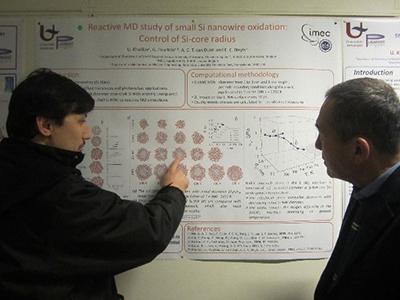
I.D. Yadgarov discusses scientific results at the University of Antwerpen in Antwerpen (Belgium)
Projects:
- 2017-2020 Fundamental research program project of the Ministry of Innovative Development of the Republic of Uzbekistan. № OT-F2-46 "Theoretical study of interaction processes of photons, atomic particles and electrons with fullerenes and carbon nanotubes"
- 2012-2016 Fundamental research program project of the Ministry of Innovative Development of the Republic of Uzbekistan. № F2-FA-F164 "Theoretical study of the processes of interaction of photons and charged particles with carbon nanostructures on the surface of crystals"
Certificates of official registration of programs for electronic computers
- DGU12638 “Program for setting the random position and direction of a cluster of atoms”
- DGU 03741 “Program for construction of spatial arrangement of atoms in homogeneous and binary diamond-like structures with vacancies”
- DGU 20180146 “A program for constructing the spatial arrangement of atoms in a defect-free fullerene with 60 atoms and changes in this fullerene”
- DGU 06320 “Program for analyzing the spatial arrangement of 60-atom deformed fullerene atoms”