
 |
The Laboratory Chief: |
Scientific directions of the laboratory:
- Synthesis of nanostructured materials based on zinc oxide and creation of hybrid heterostructures;
- Research of structural, optical and electrical properties of nanomaterials;
- Laser luminescence spectroscopy of nanocrystals, nanorods and thin films, photonic crystals;
- Nonlinear phenomena and defect induction in nanostructured materials;
- Electronic surface phenomena in silicon carbide and zinc oxide;
- Electron microscopy of nanoparticles, films and liquid structures
The laboratory staff have many years of research experience in the field of laser luminescence spectroscopy, electron and ion sputtering in crystals. They investigated luminescence in high-purity optical glasses, optical phenomena in photonic crystals, changes in the photonic band gap of artificial opal under the influence of UV radiation and when various materials are introduced into its pores, the effect of the photonic band gap of artificial opal on the luminescence characteristics of elements introduced into its pores, photon -plasmon interactions in textured ZnO films, nanoparticles and nanorods based on ZnO. Nanocomposites based on a photonic crystal and ZnO with a pronounced photonic band gap have been created, which make it possible to control the luminescence color and radiation propagating in the nanocomposite. The kinetics of aggregations and colloidal centers in the LiF / Si (111) film have been studied during low-temperature annealing, and a method for diffusion and doping with 4H-SiC has been developed.
Currently, scientific work carried out in the laboratory is aimed at creating and researching new nanostructured materials with unique properties and broad prospects for application in various fields of science and technology, including the development of solar energy. Initiative research is underway to develop a method for determining impurities in copper wire rod using secondary ion-mass spectrometric analysis. The laboratory is carrying out a fundamental project dedicated to the creation and study of heterostructures based on nanorods and zinc oxide nanoparticles. The laboratory has created a complete technological cycle for the synthesis of nanostructures (nanoparticles, nanorods and thin films) of zinc oxide.
The laboratory has a modern experimental base, which makes it possible to carry out comprehensive studies of the structure, optical, electronic and electrical properties of nanomaterials.
Main scientific results:
- A non-toxic, low-temperature method of chemical deposition from solution has been developed to obtain nanoparticles, nanorods and conductive, transparent, porous, textured zinc oxide films.
- For the first time, the intensity of the exciton luminescence band in ZnO nanocrystals is modulated by radiation from the visible range of the spectrum and the phenomenon is explained by the recharge of oxygen vacancies in ZnO.
- The influence of oxygen, hydrogen and UV radiation on the spectral manifestations of zinc vacancies in zinc oxide nanostructures, which can be decisive in the creation of heterostructure solar cells, has been discovered.
- The modification of the photonic band gap of artificial opals by introducing organic dyes and ZnO nanocrystals into its pores has been investigated.
- In nanocomposites based on artificial opal, the possibility of transferring excitation from ZnO nanocrystals to an opal matrix has been shown.
- The effect of birefringence in the nanocomposite of photonic crystals under the influence of UV radiation was discovered and investigated, and the induced change in the refractive index was estimated.
- A method for determining defects in sputtered clusters of ionic crystals has been developed.
- A method for low-temperature alloying of silicon carbide was developed and a US patent was obtained.
Nanostructures synthesized in the laboratory
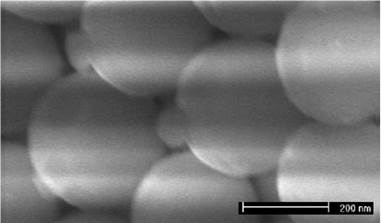
Scanning electron micrograph of a nanocomposite based on artificial opal and organic dye
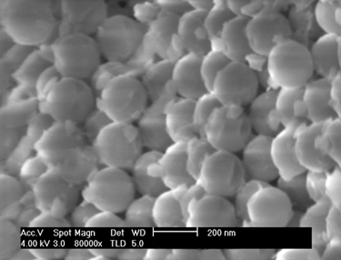
Micrograph of a cross-section of a nanocomposite based on artificial opal and zinc oxide nanocrystals, obtained by a scanning electron microscope
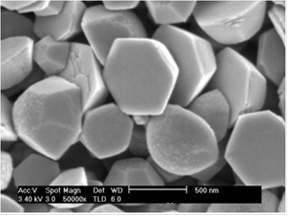
Scanning electron micrograph of ZnO nanocrystals.
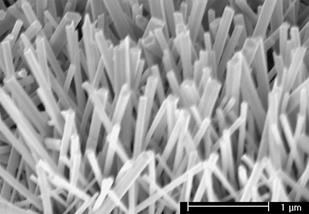
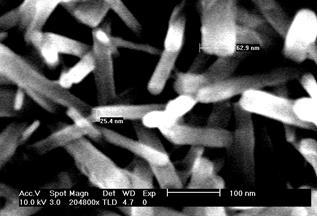
Scanning electron micrographs of ZnO nanorods.
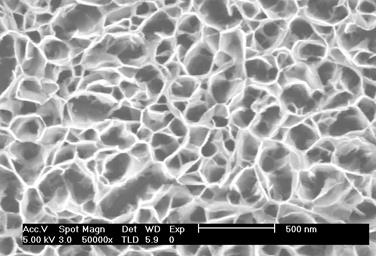
Scanning electron micrograph of a porous ZnO film.
Main experimental set-up and equipment
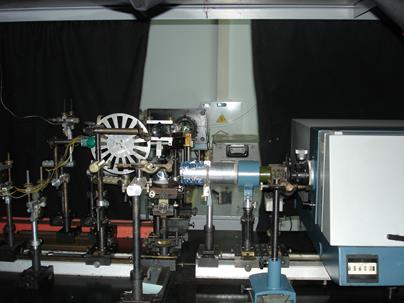
Computerized setup for measuring spectral and temporal characteristics of luminescence by pulse gating and recording time-resolved luminescence spectra of solid and liquid substances in the spectral range of 300-1200 nm.
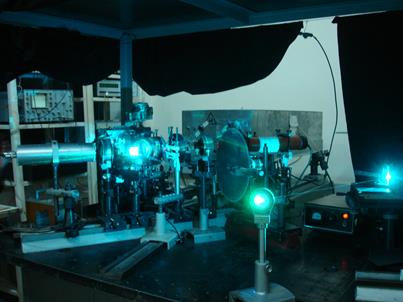
Computerized setup for measuring optical absorption, transmission and reflection spectra of samples in the spectral range 200-1800 nm based on a high-aperture MDR 23 monochromator.
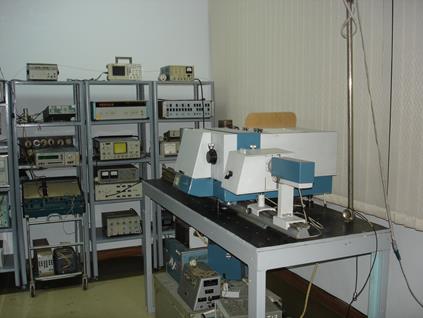
Gas lasers of various power and operating modes: N2 laser (337 nm, 15 and 100 kW), Ar + laser (457.9, 476.5, 488, 496.5 and 514.5 nm, 5 W);
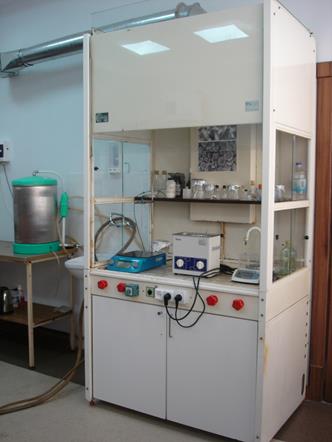
Complex of chemical equipment for the synthesis of ZnO nanostructures
Lab Collaboration:
- Dongguk University (South Korea);
- Wuhan University (China);
- Institute of Semiconductors of the Academy of Sciences of Ukraine;
- National University of Uzbekistan named after Mirzo Ulugbek;
- Samarkand State University;
- Tashkent State Technical University named after Islam Karimov;
- Institute of Nuclear Physics, Academy of Sciences of the Republic of Uzbekistan;
- Physical-Technical Institute of the Academy of Sciences of the Republic of Uzbekistan;
- Institute of Materials Science of the Academy of Sciences of the Republic of Uzbekistan